
Wayne County Deed Types
A deed records a transfer of an interest in land. In Wayne County, deeds sit within a much larger Recorder collection. That collection includes mortgages, assignments, releases, affidavits, final decrees, surveys, subdivision plats, annexations, cemetery deeds, condominium papers, mechanics liens, and federal tax liens. The deed type signals what kind of transaction took place. Still, the instrument itself and its legal description must be read. Only then can any conclusion about ownership be drawn.
| Deed Type | What It Does | Common Use |
|---|---|---|
| Warranty deed | Conveys the stated interest with deed warranties | An ordinary sale |
| Quitclaim deed | Conveys only the interest the signer may hold | Family or title cleanup transfer |
| Personal representative deed | Conveys land through an estate representative | Probate sale or distribution |
| Trustee deed | Conveys property held or sold by a trustee | Trust administration or authorized sale |
| Tax deed | Documents title issued after the statutory tax-sale process | Delinquent-tax property |
A mortgage or lien is not a deed. It can burden the property without transferring ownership at all. After locating the first mortgage or lien, search the follow-up filings. These include assignments, modifications, releases, and satisfactions. A later release should cite the same obligation as the document it clears. It may also cite the recording reference of that document. The Wayne County Recorder is the custodian of all of it. When an index label and a recorded image disagree, the image controls.
Wayne Deeds Cross Two Cutoffs
Wayne County has kept recorded instruments since 1811, five years before Indiana statehood. Online coverage is far newer than that. The Doxpop county coverage table puts the Wayne index start in January 1994. It also lists the scanned-image start in April 2000. An online miss before those dates does not mean no deed exists. It means the search shifts to older index books, microfilm, or the Recorder counter.
The county reports microfilm for every Recorder document and scanning since 2000. That explains why an index citation, an image, and the original public record may differ. Each can have a different access path. Gather the party names, date span, property description, and any book and page already known. Then ask staff for an older volume. Review the Wayne Doxpop entry point before visiting the office. The official index page displays the public search route.
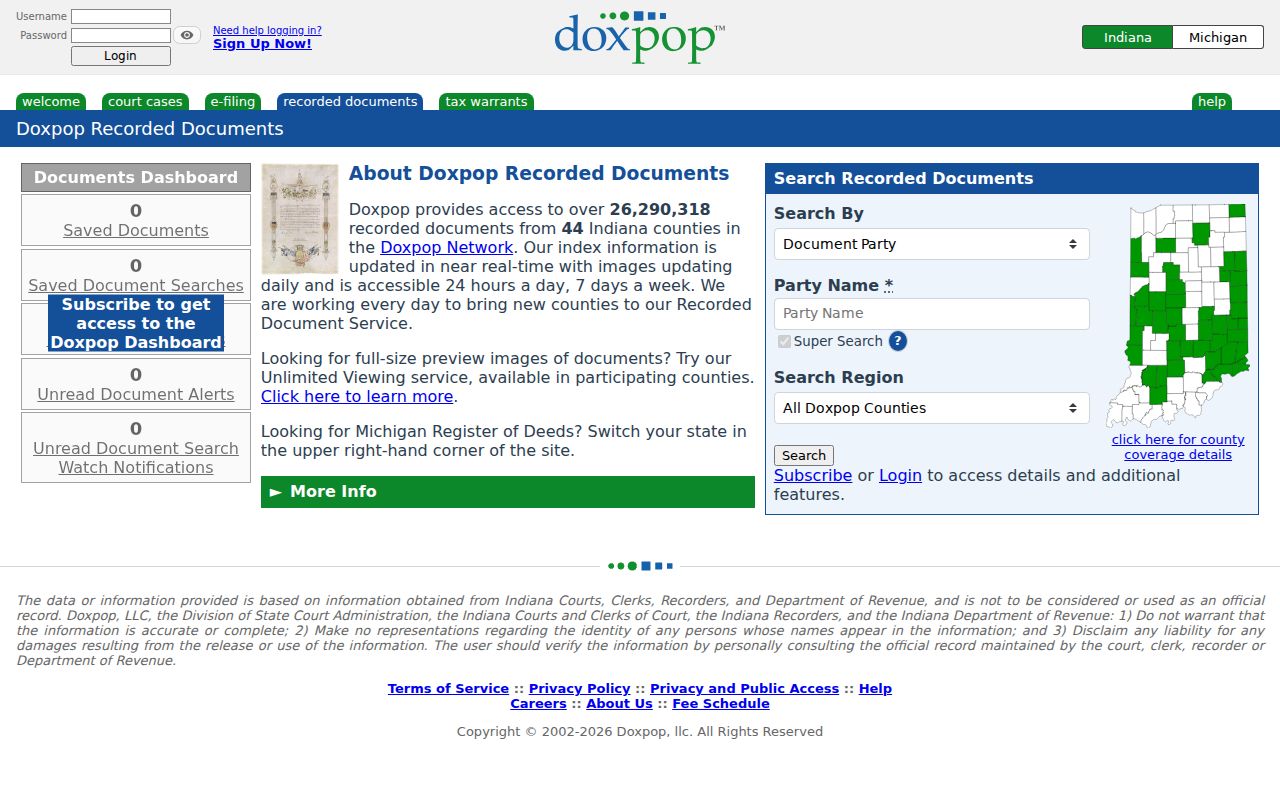
That index gateway is a starting point, not proof that every older deed image is online.
Follow Wayne's Grantor-Grantee Chain
The grantor gives or conveys an interest. The grantee receives it. Wayne County deed records are indexed under both roles, so a chain can be traced backward from a current deed or forward from an older owner. Names alone are weak evidence. At every link, compare the legal description, deed date, recording date, instrument type, and the book/page or instrument reference before accepting the connection.
- Find the latest purchase deed by searching the present owner as grantee. Confirm the parcel through its legal description.
- Copy the grantor's name exactly, plus the deed date, recording date, and document reference.
- Search that grantor as a grantee in an earlier period. Repeat while the same land description continues.
- Branch for an estate, trust, sheriff sale, tax sale, merger, or name change. Move to deed books when the online index ends.
- Grantor
- The party that conveys the stated interest.
- Grantee
- The party that receives the stated interest.
- Chain of title
- The linked sequence of instruments affecting ownership of the same land.
- Book/page
- A volume and page citation used to retrieve a recorded document.
- Instrument number
- A unique filing reference assigned to a recorded document.
Historic Wayne Deed Books
The Indiana State Library microfilm inventory is a roadmap for the pre-digital chain. It lists land-entry patent deeds from 1805 through 1838. Deed records in lettered volumes run from 1811 through 1839. Numbered volumes 1 through 114 span 1839 through 1901. Grantor and grantee index series overlap but cover differing spans. Richmond lot indexes extend from 1820 through 1910.
Use the precise series name and date span in any request. A nineteenth-century city lot may call for a lot index. Rural land may be described by section, township, and range. Probate real-estate records, partition files, and plats can bridge a gap in the chain. Historical books and newspapers may supply a prior name or old street clue. They do not replace the deed itself.
Wayne Plats Shape Deed Meaning
A short lot-and-block description points beyond the deed to a recorded plat. Wayne's Recorder collection includes subdivision plats, surveys, condominiums, annexations, dedications, and vacations. Pull the referenced plat, then check for a later replat, correction, vacation, or annexation exhibit. Roads and utility strips may appear there. Easements and common areas may too. A parcel card does not always show them.
Cambridge City's transport history offers a vivid example. A county-hosted 2019 survey cites the Original Plat of Cambridge City West of River. It was recorded in 1836 in Plat Book 1, page 17. Language about the river, canal, National Road, or railroad may describe an easement or old corridor. It may not describe the whole fee parcel at all. Current GIS serves as a visual check. It is not a substitute for the controlling instrument or a survey.
Requirements Before Wayne Recording
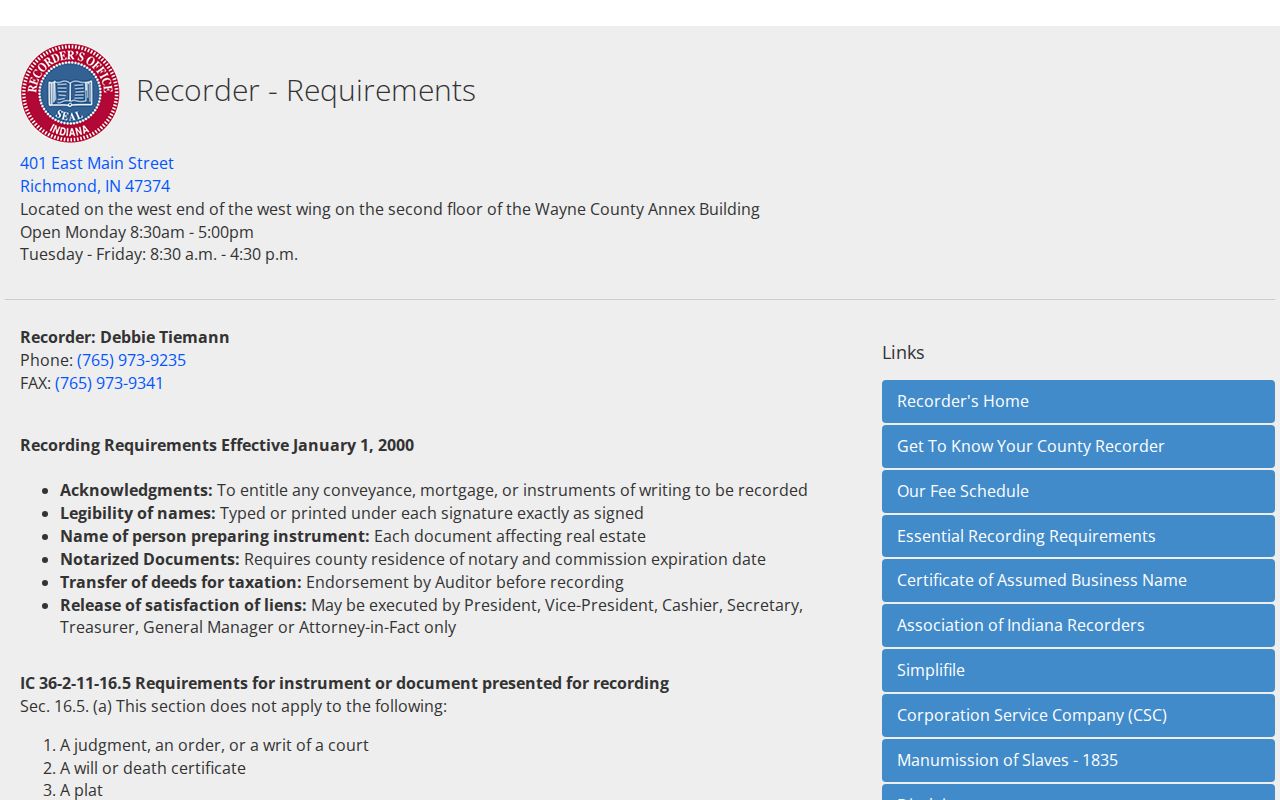
Indiana recording rules affect whether a proposed document will be accepted. Acceptance is not a legal opinion. The county's recording requirements cover acknowledgments, printed names under signatures, the document preparer, notary details, and the Auditor endorsement required on deeds under IC 36-2-11-15. The county also cites IC 36-2-11-16.5. The requirements page matters for filing a new instrument. It is not merely for reading an old one.
Recording puts a deed into the Wayne County public record. A stamped instrument proves the recorder received it, nothing more. Questions of validity, priority, or title can still arise, and those disputes are settled by other means.
Mortgages and Releases in Wayne
Deeds tell only half the story. The other half sits in the encumbrance trail. Begin with the mortgage recorded after a purchase deed. Pull the borrower, lender, legal description, date, and record reference. Then chase every connected filing. Assignments, subordinations, releases, and satisfactions all modify that original mortgage. Mechanics liens may hide under either the owner's name or the contractor's. The Recorder's instrument inventory also names federal tax liens and delinquent sewer liens. Check both categories before concluding a parcel is clear.
Indiana's State Board of Accounts offers one caution. A recorder is not affirmatively required to search and certify lien results. Bring a precise request instead. Define the lien type, names, date range, and legal description. For a transaction or court matter, get the actual documents. Seek professional advice on priority or enforceability.
Wayne Property Fraud Alerts
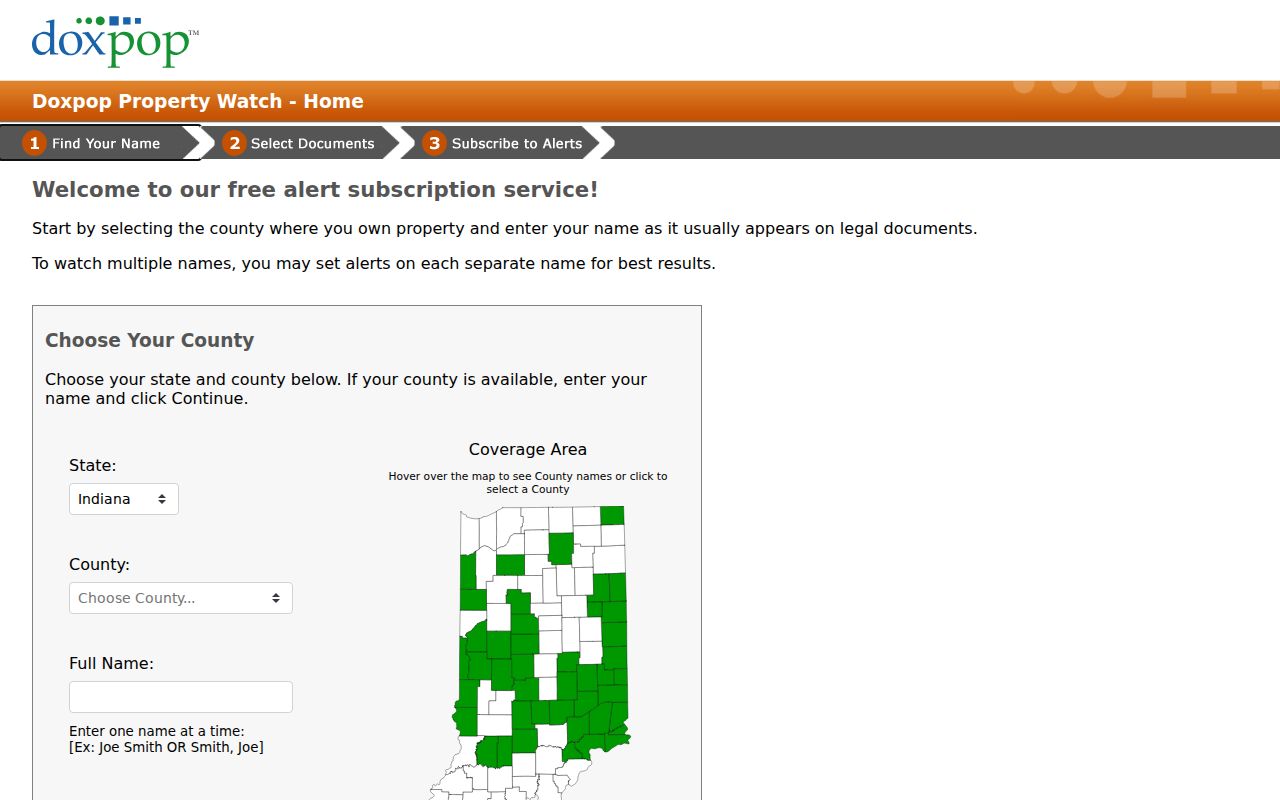
On February 1, 2024, Wayne County announced free Doxpop Property Watch enrollment. The service flags a filing that matches an enrolled name or property. Sign-up takes under five minutes, the county says. It does not block a filing or stop fraud on its own. A notice should prompt a review of the recorded instrument if it looks unfamiliar. It should also prompt a call to the Recorder. See the official Property Watch enrollment page shown below.
Treat the service as one monitoring aid. Pair it with periodic review of Wayne County deed records.
Order a Wayne County Deed
Start with any available Doxpop image. The image may be missing, older, or needed certified. In that case, contact the Wayne County Recorder at the County Annex, 401 E Main Street in Richmond. Hours run Monday 8:30 a.m. to 5 p.m. Tuesday through Friday hours are 8:30 a.m. to 4:30 p.m. The phone is 765-973-9235. Provide party names, the date, the document type, and a book/page or instrument number.
Copies and certifications carry a fee. Check the current Wayne Recorder fee schedule rather than an old quoted amount. Counter and mail requests still matter. They cover early deed books and images absent from the web. One limit stands: the Recorder cannot give legal advice or build a title opinion.
Narrow every request. Name the grantor and grantee. Give the approximate recording date and instrument type. Add the property description and any book/page or instrument number. For a long chain of title, split requests by time span and keep each index citation. Some deeds grow out of probate, foreclosure, partition, or quiet title. In those cases, find the related Wayne court case through MyCase. Request the official Clerk record. The court order shows the authority. The Recorder instrument shows what entered the land record.
Very old deeds may require the State Library microfilm route. Cite the exact grantor, grantee, lot, or deed-book series. Ask staff for records, not for a complete ownership narrative. Keep each copy with its retrieval date and citation. That habit helps a later reader. An index result, an uncertified image, and a certified public record stay distinct.
Recorded, not guaranteed. Wayne deed records show filed instruments, not every possible interest. A deed-index search is not a title opinion.