
Read Wayne County Tax Records
Wayne County splits tax records across offices. The parcel card identifies the property and its assessment fields. The Auditor maintains rates, deductions, transfers, and sale material. The Treasurer publishes billing, payment options, paperless statements, address changes, and installment channels, so read every figure with its year and its source office.
| Field | What It Shows | Where |
|---|---|---|
| Land and building value | Components used in assessment | Assessor appraisal card |
| Assessed and taxable value | Value before and after deductions | Parcel card and tax data |
| Deductions and credits | Approved reductions | Auditor and parcel record |
| Bill and status | Annual amount, coupons, and payment | Treasurer |
| Taxing district and rate | Local rate context | Auditor |
An assessed value supports taxation, while a recorded deed price reflects a single sale. The tax bill applies rates and deductions to taxable value. The numbers can differ for good reason. An unpaid bill is not a finished tax sale.
Inspect Wayne County Assessment Fields
The Wayne County appraisal card shows construction, land, value, and sales details on one page. Building area, quality, effective year, land units, base rates, and percent-good data reveal how the county assembled the mass appraisal. That detail is unusual and useful. It is still not a private appraisal. Nor is it a sale offer for the parcel.
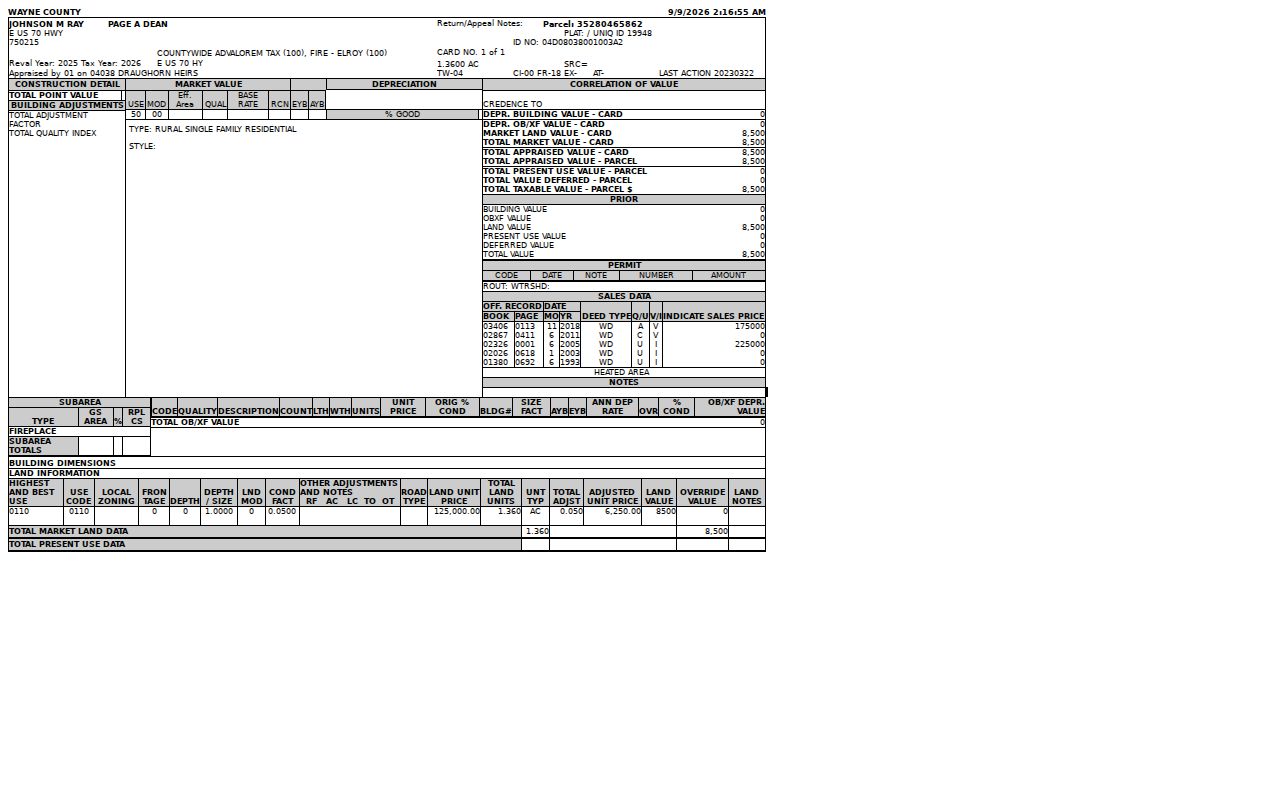
Use the card for value questions; the Treasurer answers billing.
Follow Wayne County's Tax Calendar
Indiana real property is assessed each January 1. Reassessment also happens when changes occur. Wayne County's current notice states a 2026 assessment is billed in spring 2027. For that 2027-pay cycle, 2026 sales trending draws on 2025 sales. The lag is easy to miss. A recent purchase, a parcel value, and a tax bill can each carry different years. Bills go out once a year by April 15. Spring and fall coupons split the payment. A later deed or permit can post after the valuation date, so save both the assessment year and the payable year before comparing anything.
Note: Label every Wayne County tax figure with its assessment year and payable year before comparing records.
Check Wayne County Tax Deductions
The Wayne County Auditor deduction page is the official starting point for homestead, credit, and Circuit Breaker information. A deduction trims taxable value. It does not change the parcel's market-value estimate. Confirm the filing year, the eligibility rules, and that the deduction sits on the correct parcel.
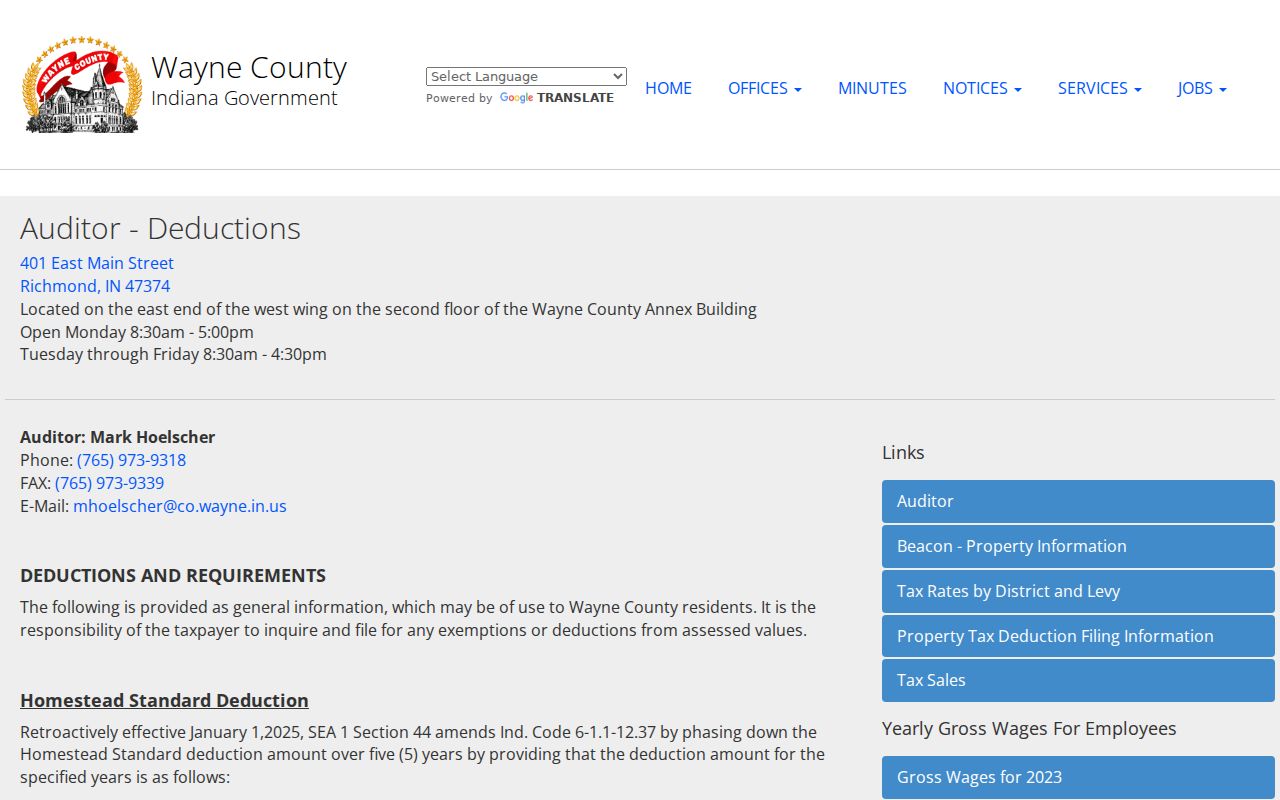
This source is better than inferring a benefit from the final tax amount alone.
Decode Wayne County Tax Districts
Wayne County holds 15 townships and 34 taxing districts. The district ties a parcel to local rates. A mailing city or ZIP does not establish the district. Annexation, district changes, and parcel splits can shift the picture over time, so confirm the county fields against the Auditor's rate table for the same year.
- Assessed value
- Value placed on property in the assessment system.
- Taxable value
- Value remaining after applicable deductions and adjustments.
- Tax levy
- The amount a taxing body raises through property tax.
- Homestead deduction
- A qualifying reduction governed by Indiana rules.
- Tax lien
- A claim tied to unpaid tax, distinct from the bill itself.
Look Up Wayne County Tax Bills
The Wayne County real-estate search supports owner, parcel, zoning, address, sales, and land-unit modes. An exact parcel number works best. Address mode helps. It separates house number, street name, and street type, and the Treasurer then supplies the current bill and payment channels for the parcel.
- Search the Wayne County real-estate portal by address or parcel and confirm the legal property.
- Record the tax year, land, building, assessed, and taxable values.
- Review deductions on the parcel and compare them with current Auditor guidance.
- Open the Treasurer page for the bill, installments, payment status, or paperless statement.
- Situs
- The physical address assigned to the parcel.
- Parcel number
- The county identifier used to keep searches on the right land.
- Payable year
- The year in which tax based on an earlier assessment is billed.
- Delinquent tax
- Tax that remains unpaid after its due date.
Track Wayne County Tax Sales
The Wayne County tax-sale page sets the 2026 sale for October 15 at 10:00 local time in the Commissioners' Chambers. Registration closes at 9:50. Bid payment is due by 3 p.m. The annual list runs in the Palladium Item and Western Wayne News, with web updates posted on Fridays. Terms change each cycle.
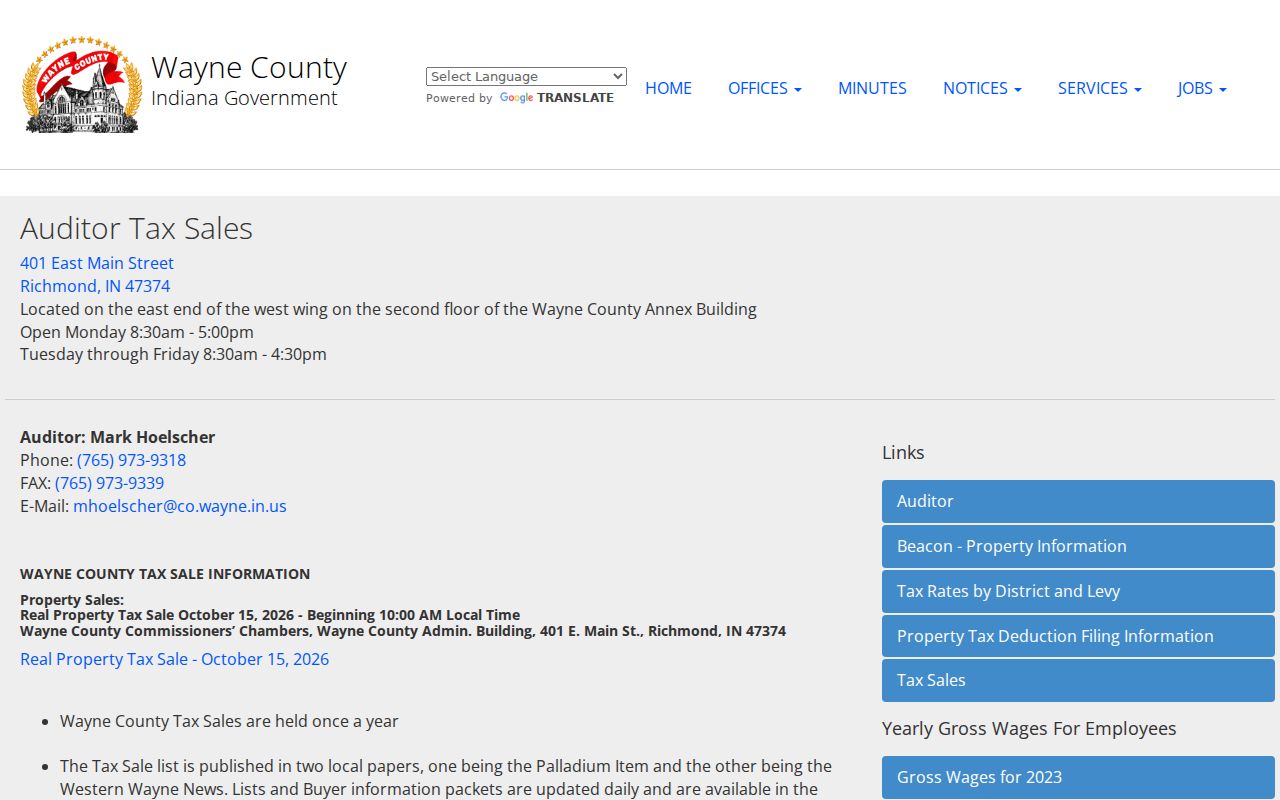
Terms here follow the sale cycle. A certificate is not a tax deed, and neither one is the same as a parcel-card ownership change.
Reach Wayne County Tax Offices
Online tools are not the only channels. The Wayne County Assessor, Auditor, and Treasurer all sit at 401 E Main in Richmond. The Assessor handles value and PTABOA review. The Auditor keeps rates, deductions, transfers, plats, and sale records, while the Treasurer manages bills, payments, and public inspection of nearly 40,000 parcel tax records.
Wayne County Assessor
401 E Main, west wing first floor
765-973-9254
Monday 7:30-5; Tuesday-Friday 7:30-4:30
Auditor and Treasurer
401 E Main, Richmond
Auditor: 765-973-9317
Treasurer: 765-973-9238
A particular existing record can also be requested under Indiana APRA, IC 5-14-3. Name the parcel, tax year, document, and format.
Appeal Wayne County Assessments
The Assessor serves as secretary to the County Property Tax Assessment Board of Appeals. Wayne County's 2026 notice sets June 15, 2026 as the appeal deadline. Review runs electronically through Beacon. Evidence must fit the parcel. Qualified comparable sales, factual card errors, and records of the relevant land and building condition all work. They must match the assessment date.
Appeal window. The stated Wayne County deadline for the 2026 assessment cycle is June 15, 2026; verify the current notice before filing.
The Indiana DLGF assessed-value search offers standardized county data with year guidance, useful as comparison evidence in a Wayne County appeal. File through the county's stated channel.
Separate Wayne County Payment Records
The Treasurer runs several payment channels. These include ProperlyTaxes and Forte, along with QuickView for paperless statements. Those screens work fine for a live transaction. What matters for your files is the saved record itself. It should show the parcel number, installment, tax year, amount, and confirmation. Add the date you accessed it. Convenience fees vary by vendor channel. Check them at the point of payment instead of trusting an old receipt. Wayne County property tax records pulled from different routes may print different fee lines.
Other Treasurer options include a ten-month installment form, an ACH form, and a mailing-address change route. An address change only affects where the bill goes. It does not touch deed ownership. A payment confirmation proves a stated amount was processed. It says nothing about assessed value, the legal description, or title. Take a missing payment or balance question to the Treasurer. Take a value error to the Assessor.
For older or disputed property tax records, request the statement or ledger entry by parcel number and year. Inspection under APRA generally costs nothing. Copies and nonstandard formats may follow fee schedules, so ask before ordering. Keep the response alongside anything you saved from a portal. Later readers can then tell a live screen from an office copy or a payment receipt.
Test Wayne County Sales Evidence
The Wayne real-estate portal has a sales search. You can filter it by city or township, date, price, property class, vacant or improved status, qualified status, neighborhood, and acreage. Those filters are good raw material for an assessment review. The flags still demand care. A qualified sale usually carries more weight for market comparison than an unqualified transfer. Zero-dollar deals, family transfers, estate and corrective deeds, and entity shuffles should never be read as ordinary open-market sales. Check the deed and its disclosure context first.
The parcel and appraisal cards display multiple sales rows alongside value fields. Preserve the sale date, price, qualification flag, vacant or improved status, and the parcel characteristics behind each comparison. Then read the deed reference tied to the row. A sale row and an assessed value are separate Wayne County property tax records. Neither one should be bent to match the other.
Valuation date matters too. A renovation, demolition, split, or new permit can occur after a sale. That can make the transaction a weak match for the current assessment. Use the appraisal card's land and construction details to test whether two parcels truly compare. A card may show an unclear owner or legal-context label. Copy the wording exactly and ask the Assessor rather than guessing.
The county's current annual-assessment notice says assessments aim to reflect market value through mass appraisal. That is not a private appraisal of one property. For an appeal, group your comparable records by the same assessment date. Use similar use and physical features, location, and qualified-sale status too. State data from DLGF can widen the pool. Wayne County still supplies the parcel card and handles the local review.
Keep exemption evidence apart from comparable-sale evidence. A deduction lowers taxable value after eligibility is proven. It does not show the Assessor's land or building estimate is wrong. A tax rate dispute and a valuation dispute also travel through different records. Name the claimed error before you gather documents, so the filing lands with the office that can actually fix it.