
Wayne County Ownership Sources
Several sources carry Wayne County property records, and each fits a different era. For recent instruments, the Doxpop Recorder index is the quickest starting point. Its Wayne County coverage begins in January 1994. Scanned images follow from April 2000. The longer official series rests with the Recorder, whose instruments date to 1811. Every document exists on microfilm. Records filed since 2000 have been scanned.
| Source | Years It Covers | Where Held | What It Shows |
|---|---|---|---|
| Doxpop deed index | January 1994 forward | Online and Recorder | Names, instruments, dates, and recent images |
| Recorder deed books | 1811 forward | County Annex | Deeds, plats, surveys, releases, and affidavits |
| State Library microfilm | Early 1800s to 1901 | Indiana State Library | Grantor/grantee indexes, deeds, and lot indexes |
| Land-entry patents | 1805 to 1838 | State Library holdings | Patent evidence before later deed chains |
Even for an old house, pull the current parcel card first. It provides a modern parcel number, a deed reference, and legal wording that can bridge an address change. Next, obtain the latest deed. That instrument names the grantor, the party transferring the property, and the grantee, the recipient. The grantor then becomes the next name you search backward through the deed records.
Use Wayne's 1994 Cutoff
Doxpop's date boundary is a routing clue. It is not the start of ownership in Wayne County. Search the recent names online first. Record the instrument number or book and page. Also note the legal description and both the execution and recording dates. Once the chain crosses before 1994, move to the office or microfilm. A 1990s index entry may lack a scanned image. The Wayne County Recorder supplies copies and certified copies under its current fee schedule.
The office sits in the County Annex at 401 E Main Street in Richmond. It is on the west end of the second floor. Published hours are Monday 8:30 a.m. to 5 p.m. and Tuesday through Friday 8:30 a.m. to 4:30 p.m. Call 765-973-9235 before a research trip. Staff cannot give legal advice or certify a lien search as complete.
The Recorder's instrument rules help you read the file. Deeds generally pass through the Auditor before recording. Always check an index hit against the actual legal description on the property records.
For recent transfers, the Doxpop Recorder portal offers the online entry point.
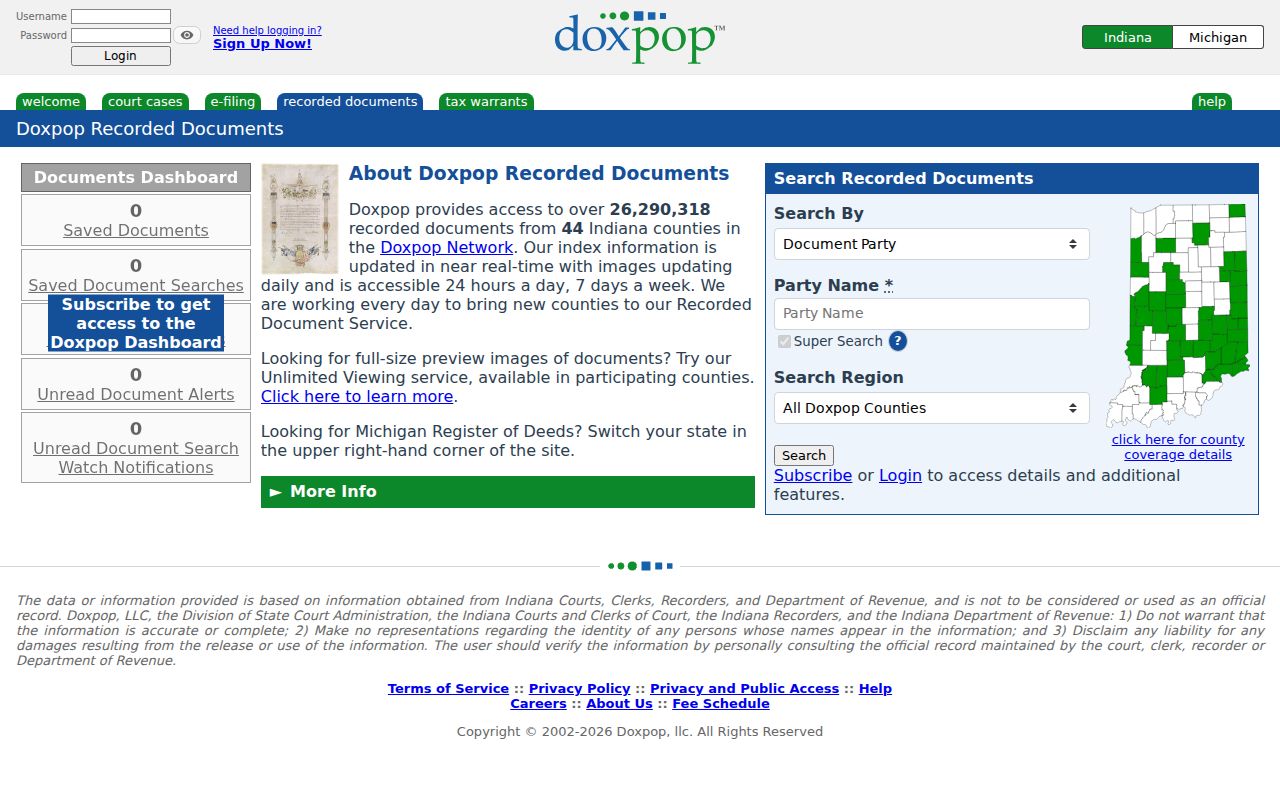
Carry each name and recording identifier from the portal into the deed image. Compare the land description before adding anyone to the ownership chain.
Walk Wayne Deeds Backward
Start with the newest deed matching the subject parcel. Note every party, the deed type, legal description, consideration if shown, recording date, and book/page or instrument identifier. Then search that deed's grantor as a grantee on an earlier instrument. Repeat the handoff until the chain reaches the period you want.
- Find the current parcel and latest deed reference.
- Pull the deed and read its grantor names.
- Search each grantor as an earlier grantee.
- Match the lot, block, acreage, and legal description.
- Log the source before moving backward again.
- Grantor / grantee
- The transferring party and receiving party on a deed.
- Chain of title
- The ordered sequence of recorded transfers for the same land.
- Legal description
- The land wording used to match records when an address changes.
A simple sequence can break. Trusts, entities, marital transfers, splits, and combinations all interrupt it. Search plats, surveys, annexations, condominium declarations, and vacations whenever the wording changes. See Wayne County deed records for the instrument method.
Wayne Estate Ownership Transfers
A former owner may vanish from the deed sequence. This can happen because the property passed through an estate. Search the decedent's name, the estate, the personal representative, any trust, and successors in Doxpop. Several instruments can help. These include a representative deed, a survivorship affidavit, a final decree, or a later deed from heirs.
Check Indiana MyCase for a public Wayne probate case. Then request the official file from the Clerk. Petitions, inventories, orders to sell, reports of sale, and distribution decrees can each explain a transfer. Older coverage varies. State Library holdings include wills from 1812 to 1920 and estate indexes from 1818 to 1961. There are also partition records from 1857 to 1904 and probate real-estate files from 1872 to 1899.
Centerville's Changing Lot Context
Centerville poses a distinctive history problem. Its 1814 plat, county-seat era, later annexations, and ward changes may clarify a parcel's setting. They do not prove title. They simply show when to look for an ordinance exhibit or old plat. Check those alongside the deeds. Compare courthouse-area lot references with today's GIS polygon. The county seat moved to Richmond in 1873. An old institutional label may no longer match one parcel.
Centerville's library access to Ancestry can yield name and newspaper leads. Cambridge City Public Library archives offer another local route. Every clue must end in a recorded record. That means a deed, probate order, plat, or certified copy of the property records.
Wayne's Deed Book Roadmap
The State Library inventory lays out Wayne County deed books with unusual precision. Lettered volumes A through Z cover 1811 to 1839. Numbered volumes 1 through 114 take over from 1839 to 1901. Grantor indexes span 1813 to 1903 across overlapping series. Grantee coverage starts in 1814 and runs to 1887. Town lots get their own treatment. Richmond lot indexes stretch from 1820 to 1910. Other town indexes follow separate spans.
Note the exact series you consult. An index range is not a deed-book range. When the trail reaches the settlement era, land-entry patents from 1805 to 1838 may supply the next link.
Town-lot indexes deserve their own pass because the library inventory never treats Wayne deeds as one continuous series. Early deed records sit in the lettered volumes, later ones in the numbered volumes, and grantor and grantee indexes can cover different spans. A careful search log names the index, letter range, volume, page, and date, because citing "county deeds" alone tells a future researcher nothing.
Historic context can break a name problem open even when it cannot prove a transfer. State Library newspaper indexes, early marriage material, school enumeration, and probate microfilm may tie a family, business, or street term to the tract. Cambridge City school enumeration covers 1896 through 1911. Centerville and Wayne Township material runs from 1896 through 1924. Use those records to surface name variants. Then return to the deed, probate order, plat, or patent for the ownership conclusion.
Wayne Mortgage Records Test the Chain
Deeds anchor any former-owner search in Wayne County. Mortgages, assignments, and releases test whether the sequence holds. Search each owner name for mortgages recorded during that same ownership period. An assignment names a later holder of the debt. A release or satisfaction shows the claim was discharged. These instruments never transfer fee ownership. They add dates, names, and legal-description language that can separate two people sharing a name.
The Wayne County Recorder also lists mechanics liens, federal tax liens, real-estate contracts, trustee elections, affidavits, and final decrees among its records. Follow each lien to its release. A judgment or later deed can close it out instead. When litigation appears, use Indiana MyCase to identify a public Wayne court file. Then obtain the official document from the Clerk, or the recorded instrument from the Recorder.
Execution and recording dates may differ. Preserve both. Record consideration only as the instrument presents it, since a nominal figure or exempt transaction is not a reliable sale price. When a deed names an LLC, search the exact entity in Indiana's INBiz system, but keep the recorded deed as the ownership evidence.
How Far Wayne Ownership Reaches
Wayne County instruments reach back to 1811, before Indiana statehood. Land-entry patents push the possible evidence to 1805. A full former-owner chain may cross Doxpop, office microfilm, deed volumes, town-lot indexes, probate files, plats, and patents. Stop when the legal description no longer matches, the tract crosses a jurisdiction, or the evidence requires a title opinion. Old directories and family histories can guide the work. They cannot establish ownership.
Lawful use. Former-owner research supports house history, estate work, and property diligence. Never use names or mailing details to track, threaten, or harass a living person.