
Wayne County Value Fields
The appraisal card separates value concepts that should never be blended. Market value is the assessor's mass-appraisal estimate. Assessed value is the official Wayne County assessment figure. Taxable value reflects what remains after applicable deductions or adjustments. Sale rows report transactions and carry flags that shape their usefulness as comparisons.
| Value | What It Is | Where |
|---|---|---|
| Assessed value | Official value established for assessment | Wayne appraisal card |
| Taxable value | Value after applicable deductions or adjustments | Parcel and tax records |
| Sale price | Recorded amount tied to a transaction | Sales rows and recorded deed |
| Land and improvements | Separate components for site and structures | Appraisal card |
Indiana assesses real property annually. January 1 is the assessment date. A sale is one event between parties, while an assessment comes from a countywide valuation process, so compare the same assessment year and property state before drawing any conclusion.
Read Wayne Appraisal Details
The Wayne appraisal card shows land, building, and other-feature components. Construction data sits behind each value. The inspected sample lists area, quality, base rate, replacement cost new, effective year built, actual year built, and percent good. Replacement cost new estimates rebuilding cost before depreciation. The official card screen makes plain how those structural inputs sit behind a Wayne County property value. Replacement cost is never a likely sale price, though.
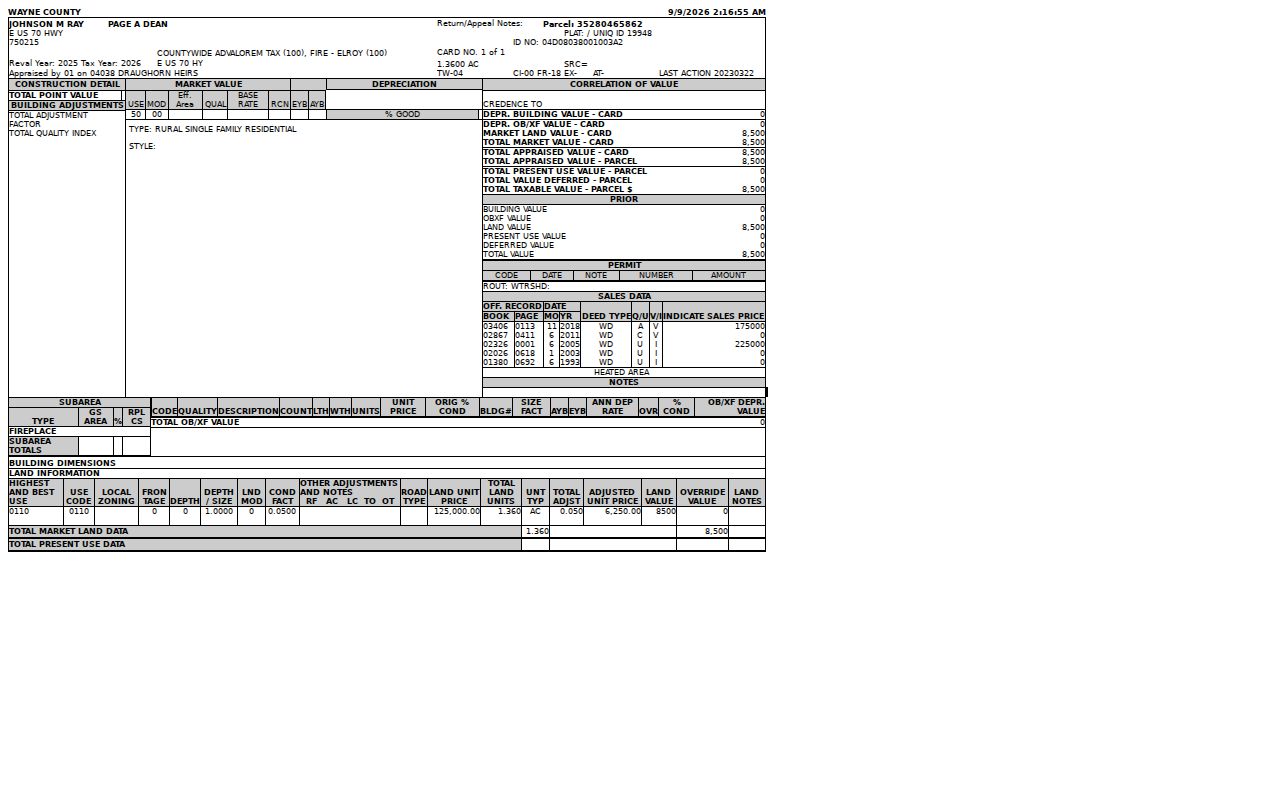
Read the component rows before comparing two parcels. Similar street addresses can hide real differences in building area, age, quality, condition, outbuildings, or land characteristics.
Wayne Sales Need Context
One Wayne County record can carry several sales rows. Qualified and unqualified transactions appear, along with improved or vacant sale indicators. Qualified rows met the market-analysis criteria. Unqualified does not mean false. It signals conditions that keep a transaction from serving as a routine comparable.
Zero-dollar entries, family transfers, estate changes, sheriff or tax-sale conveyances, and partial-parcel transfers need the recorded instrument. Confirm the consideration, parties, legal description, and deed date through the Doxpop Recorder index or the Wayne County Recorder. Never substitute the newest sale row for assessed value.
Look Up Wayne Property Value
Use the Wayne Real Estate Basic Search. Match the correct parcel before reading any values. Address fields split street number, name, and type, while the parcel number is often the cleanest key once known.
- Search the address and verify the situs and legal description.
- Open the appraisal card and note the displayed tax year.
- Record land, improvement, assessed, and taxable figures separately.
- Review sale rows and their qualification and improvement flags.
- Confirm a relevant transaction in the recorded deed.
- Assessed value
- The official value entered through the assessment process.
- Taxable value
- The value remaining after applicable deductions and adjustments.
- Mass appraisal
- A standardized valuation process applied across many parcels.
The Wayne County Assessor sits at 401 E Main Street, west wing first floor. The office phone is 765-973-9254. Published hours open at 7:30 a.m. weekdays, closing at 5 p.m. Monday and 4:30 p.m. Tuesday through Friday.
Wayne's Assessment Calendar
Dates matter in Wayne County. Years must match. A parcel card, a tax bill, and a sale may each describe a different period. The Assessor states the 2026 assessment tax bill will be mailed in spring 2027, and its current notice says 2026 sales trending for taxes payable in 2027 relies on 2025 sales. The listed 2026 appeal deadline was June 15, 2026, with electronic review and appeal routed through Beacon. Those dates describe the 2026 cycle. Recheck them for a later year. Keep the appeal notice and parcel card. For a detailed tax-bill route, use Wayne County property tax records, because the bill is a different record from the valuation evidence.
Deductions Change Wayne Property Value
Homestead and other deductions can lower the taxable figure in Wayne County. The physical description stays the same. The Auditor maintains deduction information and posts county forms. Eligibility, filing dates, and transition rules vary by deduction, so rely on the current Auditor deductions page rather than copying an older amount.
A lower taxable value is not a market signal. Circuit breaker limits address the tax burden, not a parcel's sale price. Keep assessed value, taxable value, deductions, and taxes in separate columns. Years compare cleanly that way.
No single stable amount applies to every parcel. Record the deduction name and year. A deduction that starts or ends between two years explains part of the taxable-value difference. Explain that change before treating the difference as a reassessment of the land or improvements.
Compare Wayne Property Value Data
Indiana's Department of Local Government Finance maintains statewide assessed-value tools. Its assessed value search lets you cross-check the county and year mapping. State numbers help confirm a published assessment or expose a broad pattern. They cannot replace the parcel-level construction detail on a county appraisal card.
Municipal records can explain a change without setting a value. A Richmond permit or zoning case may document an addition. Centerville annexation material can clarify which jurisdiction actually holds the parcel. None of them produces a parcel estimate by itself.
DLGF data also needs careful year alignment. The county notice ties the 2026 assessment to a bill mailed in spring 2027. Sales trending for 2027-pay taxes draws on 2025 sales. Label assessment year, pay year, and sale year in separate fields. Otherwise a valid state total can look inconsistent with a county card. The records simply describe different stages of the cycle.
Wayne County holds 15 townships and 34 taxing districts. Wayne Township elects its own assessor. District context shapes the bill but cannot explain one house's appraised characteristics. Match property class, land use, building area, age, quality, and condition before comparing nearby parcels. Only then weigh broader district or municipal context.
Limits of Wayne Property Value
An assessor's figure is not a title opinion. It is also not a boundary survey, a repair estimate, or a prediction of the next sale. The number may lag a fast-moving market. It may rest on characteristics that need correcting. Verify acreage and boundaries with a surveyor, ownership with recorded instruments, and current market value with a licensed appraiser.
A wrong construction characteristic deserves attention. Preserve the parcel card and contact the Wayne County Assessor. A formal challenge follows the appeal procedure and deadline published for that assessment year. A value question involving an unrecorded addition may also need the municipal permit file. A permit cost is not added market value.
The sample Wayne appraisal card shows why detail matters. Its building calculation covers base area, quality, base rate, replacement cost new, actual year built, effective year built, and percent good. Effective year built reflects condition or modernization. Do not read it as the literal construction date. "Percent good" is a depreciation input, not a home-inspection score. Other buildings and yard improvements may sit in a separate component rather than the main dwelling figure.
Sales rows need equal care. The county sample mixes qualified and unqualified transactions, improved and vacant flags, and entries showing zero dollars. A qualified sale can feed market analysis. An unqualified transfer may involve family, estate, foreclosure, partial-interest, or other conditions. Pull the deed and sales disclosure where available before deciding what a transaction says about market value.
For a review or appeal, assemble the parcel card, photographs, construction facts, relevant sales, and the notice for the correct year. The Wayne Assessor serves as secretary of the county Property Tax Assessment Board of Appeals and directs electronic property review through Beacon. The 2026 notice set a June 15, 2026 deadline. Later cycles need the date published for that year. Missing a deadline cannot be cured by comparing a stale portal screen.
Value versus price. A Wayne County assessor value is not a promise of what property will sell for. Use a licensed appraisal when a current market opinion is needed.